
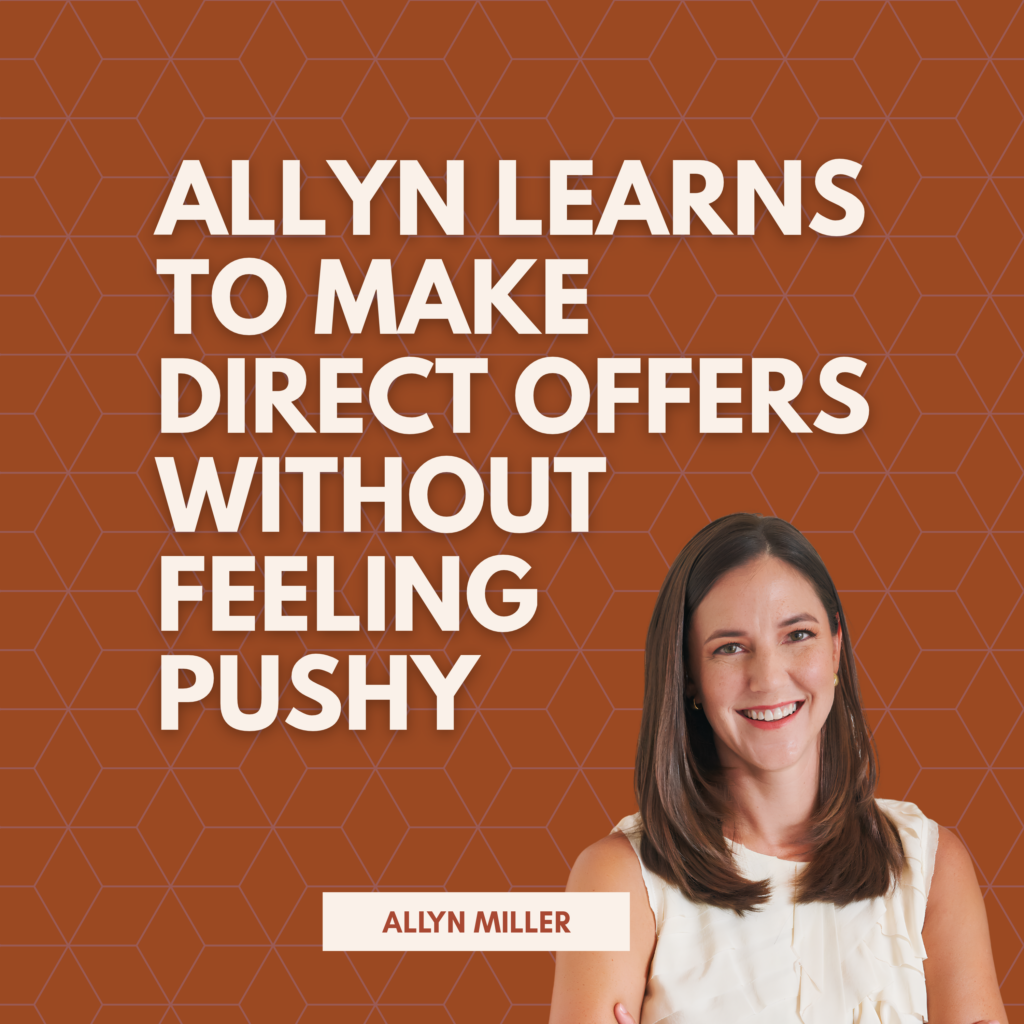
#244 : Allyn Learns to Make Direct Offers Without Feeling Pushy
with Allyn Miller 

Episode at a Glance

Allyn feels busy in her parenting coach business, but she still can’t get two to three sales calls a week on her calendar.

Allyn Miller coaches parents who promised themselves they would parent differently than their own parents, but now feel totally lost about what “good” looks like. She came to this conversation looking for a no-fluff plan to reliably book sales calls with parents, not just collaborations with colleagues or teachers.

Today’s focus is simple: turn Allyn’s lead generation efforts into actual enrollment calls by zeroing in on direct, child-centered messaging, using specificity in every pitch, and making her invitations far less polite and much more obvious. Allyn walked away with a ruthless clarity about what to say (and what not to say) in her marketing so potential clients can make a clear yes or no decision.

Let me highlight the breakthroughs Allyn and I mapped out in this conversation.

Keep an ear out for what I challenge Allyn to do with her email calls to action, especially when she admits she’s always waited for clients to make the first move.

Key Takeaways

  • Talk About the Child’s Outcome: Position coaching as something that directly benefits the child, not just the parent or their long-term relationship, so parents will treat your offer with urgency instead of as another self-help project for “someday.”
  • Make Invitations Explicit and Direct: Hiding your sales call link in a PS or soft suggestion outsources leadership to your subscriber. Go for clear, direct asks at the top and bottom of your emails.
  • Specificity Drives Relatability and Action: Use concrete examples, vivid stories, and ultra-specific CTA language to help parents see exactly how your coaching applies in their real lives and problems—they will match their situation to your stories.
  • Let People Opt Out on Purpose: Set up your emails so people either book a call or unsubscribe, freeing your list from folks who will never buy and making space for real clients.
  • Personal Outreach Isn’t Pushy: Build a simple system to reach out individually and check in directly. For Allyn, this looked like texting or emailing a few subscribers a day and asking if they want help.

Timestamps & Key Topics

[00:00] Dallas introduces Allyn and her specific enrollment hurdle
[03:00] Allyn explains her collaboration-heavy approach and why it hasn’t brought in sales calls
[05:10] Dallas diagnoses messaging and positioning problems with Allyn’s email invites
[09:15] Naming the top theories for low conversion: parent psychology and unclear invitations
[14:20] Dallas unpacks why explicit offers build more trust than passive invitations
[17:00] Shifting messaging from long-term hopes to urgent child outcomes
[23:25] “Owl versus cheese” analogy and how to avoid fear-based copy
[26:44] Case studies, testimonials, and spotlighting other moms who made the leap
[29:57] Hyper-direct marketing and the value of explicit unsubscribes
[34:00] Making your CTA concrete, vivid, and situation-specific
[39:34] Why specificity is actually more inclusive than universal language
[43:16] Breaking down the “coaching mystery” and explaining your coaching process in plain terms
[49:00] How Allyn can set up daily personal outreach to list subscribers
[51:16] Allyn recaps her action list: messaging shifts, clearer CTAs, and personal outreach system
Connect 

Allyn Miller
Allyn Miller

CONNECT WITH GUEST

Dallas Travers
Dallas Travers
CONNECT WITH DALLAS

Helpful? Check Out These Related Episodes

Join the Pod Squad

A Free Inner Circle, Intimate Access Community for Coaches on a Mission

Coming In Hot To Your Inbox Every Week...

  • Transcripts for every single episode
  • Checklists to easily put what you hear into concrete action
  • Behind the Scenes videos from Hive Coaching Calls
  • Uplighting and insightful tips from Dallas to keep you on track and rooted. 

Episode Highlights

Build a Client Attraction System That Gets Parents to Take Action

My guest Allyn Miller is a parent coach who works with folks determined to parent better than their own parents did, but now feel lost about what “good parenting” looks like in real life.

Allyn came to me with a challenge that will feel familiar to so many coaches. She’s busy and taking plenty of action, but she’s not confident those actions are actually moving the needle. Her big goal is to generate two to three sales calls each week, but those calls just haven’t been happening.

We dug into Allyn’s current efforts, broke down the gap between “being busy” and getting sales calls, and discovered four key theories behind why email subscribers weren’t converting into clients. From there, we got practical about making her invitations crystal clear and shifting her messaging to match the urgency and priorities of real parents.

Let me highlight the steps Allyn and I worked through to turn her outreach into a direct, sustainable system that gets the right people raising their hands.

Step One: Audit Your Positioning for Urgency and Relevance

If parents aren’t booking calls, your messaging might be missing the mark. Together, Allyn and I noticed she was framing her offer in long-term, relational terms like “raise a kid who comes home for the holidays,” or “be your child’s lifelong teacher.” These are important, but they invite people to put action off until “later.” Instead, positioning your offer in a way that makes the benefit immediate and relevant to the child right now connects to what parents already prioritize. When you put your offer in the same category as vitamins, private swim lessons, or speech therapy, you make booking a call feel essential instead of optional.

Step Two: Make Your Sales Invitations Direct and Explicit

We uncovered that Allyn’s invitations to book calls were often tucked away or overly polite. If you want clients to say yes (or even no), your call to action must be impossible to miss. That means putting the invitation clearly in the body of every email and being specific about the kinds of problems you help with. When your reader gets to the end of your newsletter, don’t just rely on a quiet “PS.” Instead, challenge them with something like, “If you’re dealing with [specific child behavior], this is what I help with. Book a call.” Ambivalence in your emails does not build trust or encourage action.

Step Three: Speak to the Parent’s Actual Buying Motivations

Allyn’s insights about her audience were spot on. Parents, especially moms, have a high tolerance for struggle and often seek solutions for their children before considering themselves. That means the most effective messages put the benefit to the child front and center, not as a side effect, but as the reason for taking action now. When you highlight how your coaching helps a child thrive right away, you meet parents where their true sense of urgency lies.

Step Four: Use Specificity to Build Trust and Drive Action

Generic language doesn’t move email subscribers to book a call. Specificity is what makes people feel seen and understood. This can look like telling true stories, describing vivid examples, or listing the actual behaviors parents want to address, like, “Has your kid ever called their grandma fat at a family gathering?” These details give your reader a point of real-life connection and help them see themselves in the situation. The more specific you get, the more relatable and actionable your invitation becomes.

Finally: Systematize Personal Outreach for Consistent Results

We wrapped the session by bringing strategy and heart into Allyn’s daily routine. Instead of waiting for people to respond to emails on their own, you can use a simple system for sending personal invitations. Track your new subscribers, send a short direct message or even a text inviting them to a real conversation, and rotate through your list every workday. When you make personal outreach a habit, you create more consistent sales opportunities without burning out or betting everything on hope.

And here’s a nugget you don’t want to miss: test out an even more explicit unsubscribe option in your emails. Give your reader permission to leave if your coaching isn’t what they need right now. It might feel risky, but making the “goodbye” as clear as the invitation to work with you actually delivers a better experience for everyone and helps your most committed subscribers self-select in.

There’s a lot more inside our conversation, including how to handle the “coaching mystery” when your audience doesn’t really understand what coaching is, and the simple mindset shift that takes the ick out of sales. If you want the full breakdown and some email CTA inspiration, check out this episode.